
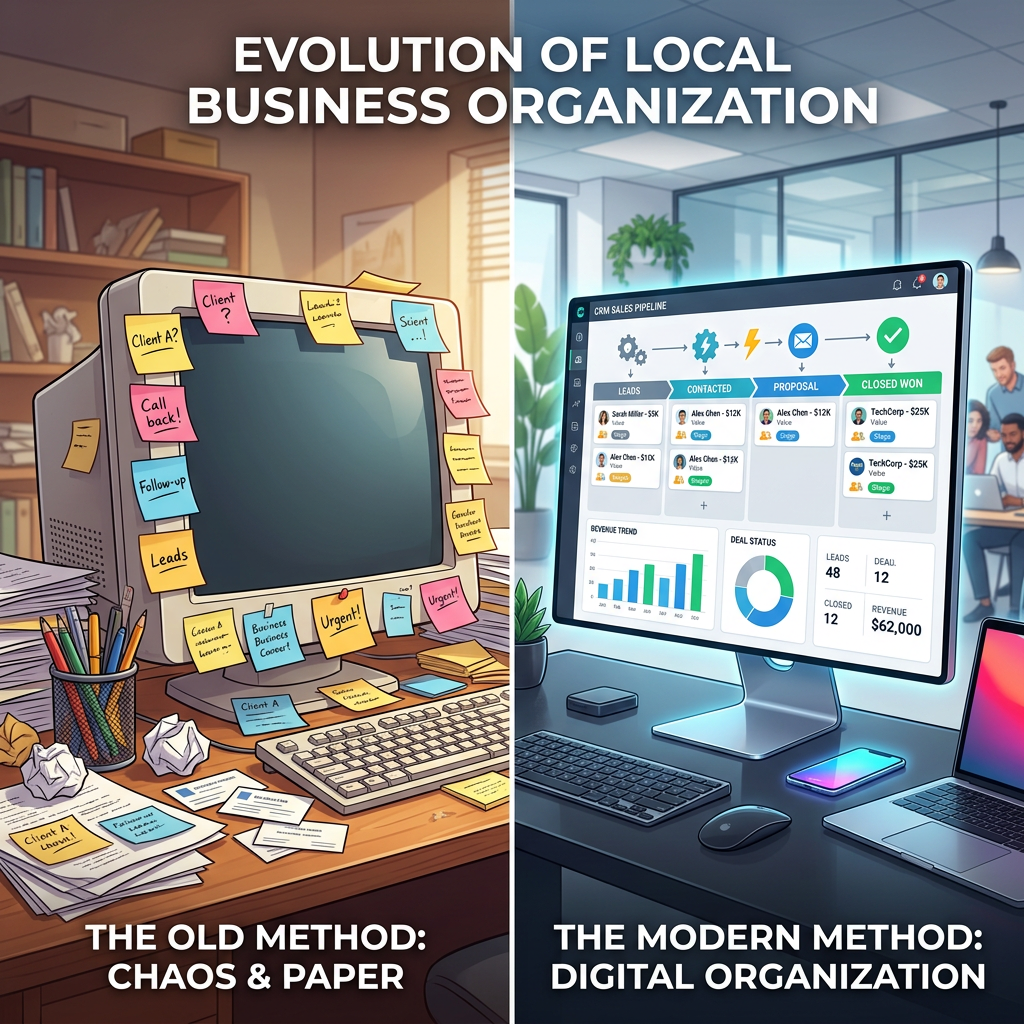
If your idea of a “sales pipeline” is a stack of sticky notes on your monitor, a stack of business cards in a drawer, or a spreadsheet only one person on your team knows how to update, you’re not alone — and you’re not doing anything wrong. Plenty of successful North Alabama businesses were built this way. But there comes a point where the systems that got you here start holding you back.
This guide walks through what CRM automation actually is, why it matters more as you grow, and what a realistic first step looks like for a local business owner who’s ready to move on from sticky notes.
What “Automation” Really Means
The word can sound intimidating, like something only tech companies need. In practice, CRM automation just means letting software handle the repetitive tasks that currently eat up your team’s day — without anyone lifting a finger each time. Common examples include:
- Sending a welcome email the instant someone fills out a form on your website
- Texting an appointment reminder 24 hours before a scheduled visit
- Routing a new lead to the right salesperson automatically, based on service or location
- Requesting a Google or Facebook review the moment a job is marked complete
- Flagging a quote as “stale” if the customer hasn’t responded in a set number of days
None of these require a new hire. Once built, they run in the background, every day, whether you’re in the office or not.
Why a Pipeline Beats Sticky Notes
A sales pipeline is simply a visual way to see where every prospect stands — new lead, contacted, quote sent, closed — usually as a drag-and-drop board. The advantage over sticky notes or a spreadsheet isn’t just that it looks nicer. It’s that:
- Your whole team can see the same information, so nothing depends on one person’s memory
- Nothing gets lost when a sticky note falls behind the desk or a spreadsheet row gets accidentally deleted
- You can spot exactly where deals are stalling — and get notified automatically when one goes quiet too long
- New team members can get up to speed by looking at the pipeline instead of asking around
For growing businesses across Calhoun County and North Alabama, that visibility often reveals problems owners didn’t know they had — like a batch of promising leads that quietly went cold three weeks ago because nobody followed up.
A Realistic Starting Point
You don’t need to automate everything on day one. Most businesses get the most value by starting with a handful of high-impact automations — a welcome email, an appointment reminder, and a review request, for example — and expanding from there as the system proves itself. This is exactly how WideNet approaches new CRM setups: we don’t hand you a blank platform and a manual. We configure specific automations selected for your business, test them, and train your team to use them with confidence.
Keeping It Organized as You Grow
One thing that trips up a lot of businesses moving off spreadsheets is data organization. A CRM is only as useful as the structure behind it — tags, naming conventions, and pipeline stages that actually make sense. That’s why WideNet built our O.O.P.S.™ (Object Oriented Planning System) framework into every Advanced CRM Setup, establishing clear organization from day one so your contacts, pipelines, and reports stay clean as your business scales — instead of turning into the same cluttered mess you’re trying to leave behind.
Where to Go From Here
WideNet’s Basic CRM Setup ($2,995 one-time) includes two workflow automations to get you started, centralized contact management, and calendar integration — a solid entry point for small teams. Our Advanced CRM Setup ($5,995 one-time) adds four automations, full sales pipeline setup with stale-lead notifications, payment processing, and our O.O.P.S.™ data framework for businesses ready to scale.
If sticky notes and spreadsheets have taken your North Alabama business as far as they can, it might be time for a real pipeline. Reach out to WideNet Consulting (widenetconsulting.com/contact/) or call 256-241-6112 to talk through which setup fits where your business is today.