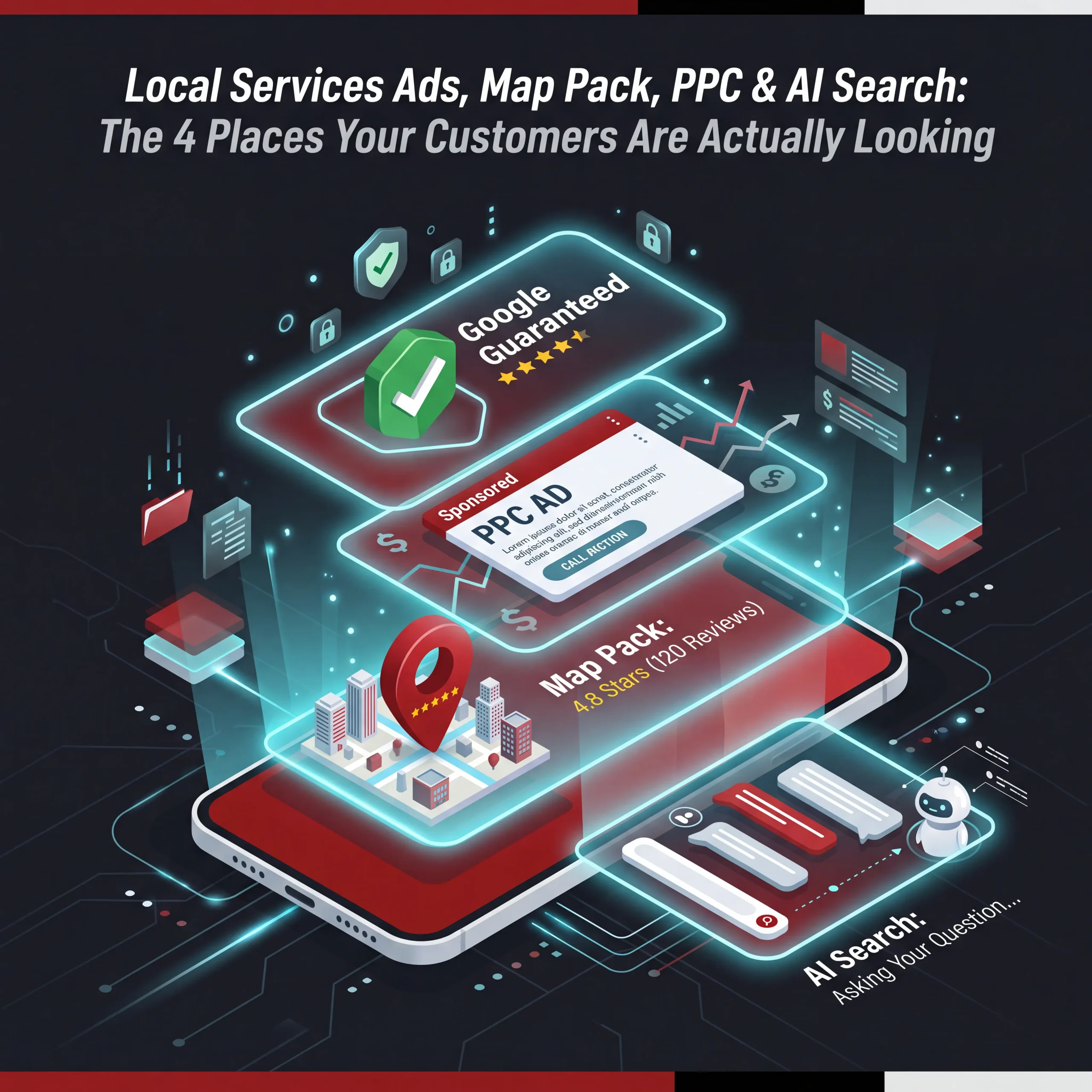
When a potential customer searches for a business like yours, they’re not scanning one list — they’re scanning four distinct zones on the page, often without even realizing it. Understanding these four zones, and making sure your business occupies each one, is the difference between being found and being overlooked.
Here’s a breakdown of where customers are actually looking, and what it takes to show up in each spot.
1. Local Services Ads (Google Guaranteed)
This is the zone at the very top of the page, above even the traditional paid ads. It’s reserved for businesses that have completed Google’s verification process and earned the Google Guaranteed badge — a trust signal that tells customers Google itself has vetted the business.
For service-based businesses especially, this is prime real estate. Customers searching with urgency (think plumbing emergencies, urgent medical needs, or same-day service requests) tend to click here first because the badge signals credibility before they’ve read a single review. Getting into this position requires setup and ongoing verification management, but the payoff is being the very first thing a customer sees.
2. Pay-Per-Click Sponsored Ads
Just below or alongside Local Services Ads sit the traditional PPC listings — the ads businesses bid on for specific search terms. This is where you capture high-intent buyers: people who already know what they want and are searching for exactly that, right now.
The key to this zone isn’t just showing up — it’s showing up efficiently. A well-managed PPC campaign targets the searches that actually convert, rather than burning budget on clicks that never turn into customers. Ad spend should be managed for return on investment, not for vanity impressions. Done right, this position captures buyers before they ever scroll down to the organic listings, including the ones your competitors are counting on.
3. Google Map Pack Listing
Scroll a little further and you hit the map pack — that cluster of three business listings pinned to a map, usually accompanied by star ratings, hours, and a “call now” button. For any business with a physical location or a defined service area, this is one of the most valuable spots on the entire page.
Earning a top-three map pack position comes down to a combination of factors: a fully optimized Google Business Profile, consistent and accurate local citations across the web, and strong, recent reviews. It’s also hyperlocal — a business optimized for “Anniston” searches may look completely different in the map pack than one optimized for “Oxford” or “Calhoun County” searches. This is why targeting the keywords your actual local customers are searching matters so much.
4. ChatGPT & AI Search Results
This is the newest — and fastest-growing — place customers are looking, and most businesses haven’t even started competing here yet. Over 30% of searches now begin with an AI tool like ChatGPT, Gemini, or Perplexity instead of a traditional Google search.
Here’s how it plays out: a customer asks an AI assistant, “Who should I hire for kitchen remodeling near Anniston, Alabama?” The AI doesn’t return ten links — it gives one confident, specific answer, often naming a business by name along with why it’s a good fit. If your business isn’t structured, cited, and optimized for this kind of query, you simply don’t exist in that conversation. This is where Answer Engine Optimization (AEO) and Generative Engine Optimization (GEO) come in — structured data, schema markup, and content strategy built specifically so AI tools recognize and recommend your business.
Why All Four Matter Together
It’s tempting to focus on just one of these — maybe you’ve already got a decent map pack listing and figure that’s enough. But customers don’t search in a single mode. Some are ready to buy right now and click the first ad they see. Others browse the map. A growing number are asking an AI assistant to do the research for them before they ever open Google. If you only occupy one of these four zones, you’re only capturing a fraction of the customers actively looking for what you offer.
The businesses that show up in all four positions simultaneously aren’t just getting more visibility — they’re building a form of digital trust. When a customer sees your name in the ads, in the map pack, and hears an AI recommend you by name, that repetition builds credibility no single listing can achieve on its own.
A North Alabama Perspective
We’ve watched search evolve firsthand since 2005, working with businesses throughout Anniston, Oxford, and the surrounding region. The fundamentals of good local marketing haven’t disappeared — but the number of places you need to show up has multiplied. A strategy built around just one of these four zones is a strategy built for yesterday’s search landscape.
If you’re curious where your business currently stands across these four zones — and where the gaps are — that’s exactly the kind of clarity a Local SEO Grid Report can provide, mapping your visibility across your entire service area.
Want a clear picture of where you stand? Reach out to WideNet Consulting at 256-241-6112 or sales@widenetconsulting.com, and let’s talk about closing the gaps.